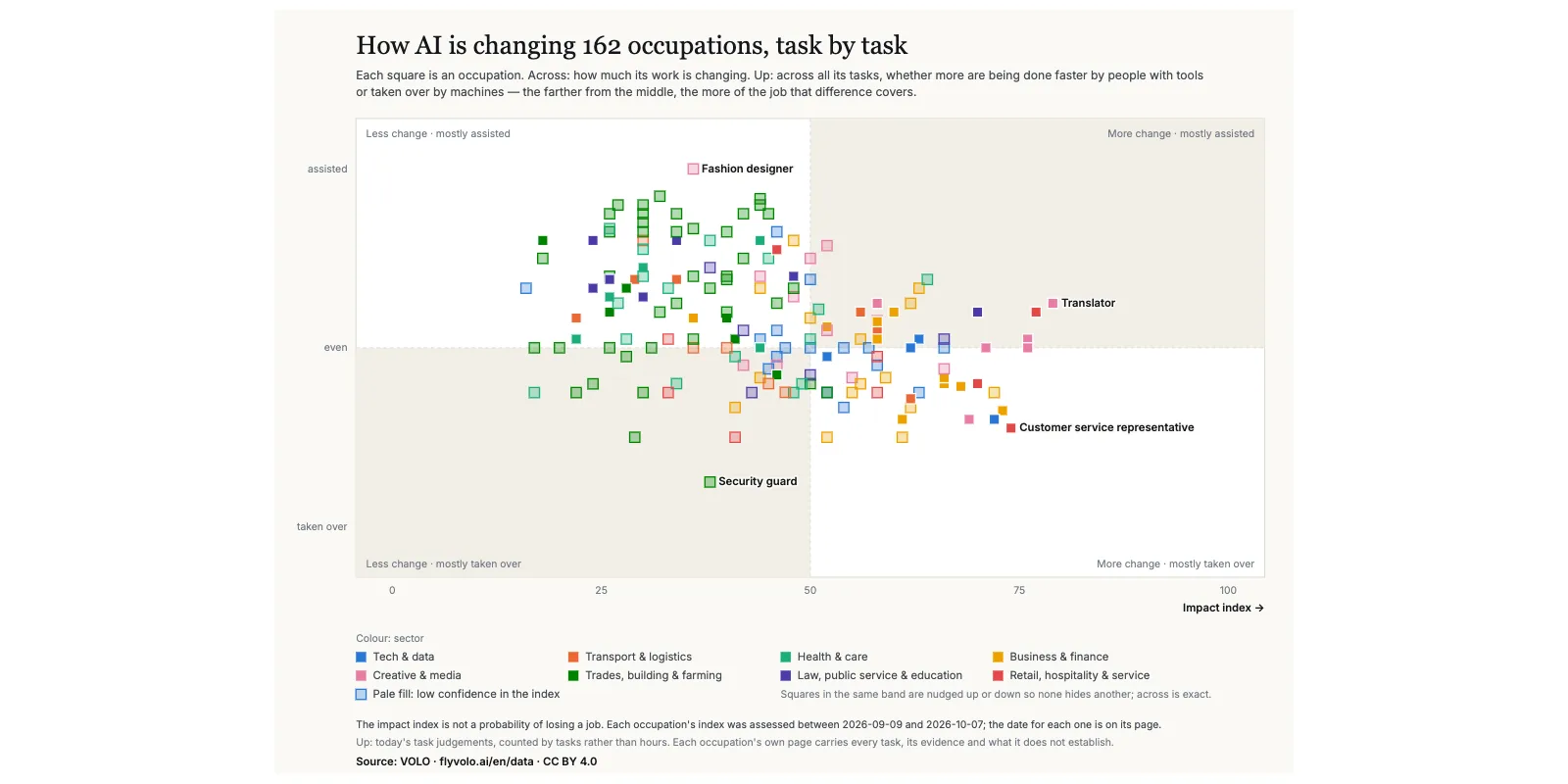
"Will AI replace my job?" More and more people no longer search for the answer. They ask their AI assistant. The assistant usually answers from what it absorbed in training: it sounds reasonable, but it cannot say where it comes from, and it does not know what happened last month.
For the past six weeks I built VOLO with an AI agent, to be the source the assistant reads: a structured, queryable knowledge base about jobs, with its evidence attached. It is free for everyone and carries no advertising.
What an AI gets from it
Judgements broken down by task. VOLO does not give a verdict on an occupation. It breaks each one into the tasks people actually do and labels every task: automating, being augmented, or still led by a person; whether that rests on a public record or on inference; and what the judgement does not establish. Today that is 162 occupations, 825 task judgements and more than 1,000 records, in six languages.
For an AI this structure is far more useful than an article. When a user says "I'm an accountant", the assistant does not get a paragraph of generalities. It gets "data entry and reconciliation are automating; explaining the numbers to decision-makers is still led by people", and every line links to its source.
Rules that travel with the data. "No years", "no probability of losing your job", "never say who to make redundant", "an inference is never presented as a finding" — these are not only on the website. They are written into the tool descriptions the AI reads, so it learns how to use the data at the same moment it receives it.
Doors built for machines:
- a public MCP server (
mcp.flyvolo.ai/mcp) with 19 tools, no sign-up, no key; - an A2A endpoint, so someone else's agent can talk to ours directly;
- a plain-text version of every occupation, record and note page (add
.mdto the URL), and anllms.txt; - one page written for AI (
mcp.flyvolo.ai): no visuals at all, just every interface and every tool's input schema; - all the data, open under CC BY 4.0.
How to connect
In Claude Code it is one line:
claude mcp add --transport http volo https://mcp.flyvolo.ai/mcp
In Claude or ChatGPT, add a custom connector with the same address. Then ask: "Using VOLO, I work as a …; which parts of my job is AI changing?"
If you want it to remember who you are, which jobs you follow and which tasks are yours, a free personal account gives you your own MCP address.
What designing for AI taught me
Leave the intent to the AI. Someone once asked "Will robotaxis replace taxi drivers?" and the assistant replied that VOLO did not cover taxi drivers — the page was right there. The assistant had passed the whole sentence to a tool that matches names, the match failed, and it repeated the failure. The fix was not more matching rules. It was telling the AI, in the tool description: work out yourself which job the person means, and if nothing matches, read the full list of occupations before deciding. Afterwards it recognised even "cabbies".
AI readers already outnumber people. In two weeks, ChatGPT opened our pages more than a thousand times on behalf of its users, and other people's AI clients called our tools about 580 times. Far fewer people came to the website directly.
But AI rarely says where it read something. The content is read and used, and the person on the other side of the screen may never learn where it came from. That is a new problem, and I do not have an answer to it yet.
What's next
VOLO is now in long-term maintenance: new records arrive three times a week, the site updates once a week, it runs on its own without anyone watching, and hosting costs about ten dollars a month.
The whole project runs with an AI agent as CTO and COO: I set the direction; it writes the code, finds the evidence and writes the post-mortems. A knowledge base written for AI to read, built with an AI. That seems about right.